Pages

Tuesday, January 18, 2011

On notice


"Stand tall. Take a few moments to experience the sensation of simply standing well. Stand barefoot with your feet shoulder-width apart, stomach muscles engaged, and the rest of your body relaxed. Spread your toes widely to feel a sense of connection with the earth. Visualize roots growing downward from your feet. At the same time, imagine there's a fine thread pulling you upward from the crown of your head. Enjoy these opposing but complementary feelings: deep stability and graceful lightness."--Barbara Ann Kipfer, from 1,001 Ways to Live in the Moment

"Dogs live in the moment," Mike observed, as our puppy Carmelita lay on her back, one hind leg stretched toward him, her eyes rolled back, her front paws extended in the air. "Look at her, she's so relaxed."

Lucky her.

I spent this holiday weekend fretting about my to-do list. I had tried setting reasonable goals for myself by just writing down a couple of things each day in a Mini Goals Notepad. I had done this successfully at work when I knew I was leaving for vacation, and it had helped me focus and get some stuff done that I had been putting off for weeks.

But at home I couldn't stop at two to-dos. I wrote down ten things. Some were as simple as "go buy the Sunday paper" which Mike regarded as more of a reward than a task. Others were "send out submissions to magazines" which I could have spent all three days doing. I did go to the gym. Once. Then I went home and ate sponge cake with strawberries and sugar, tortilla chips, a burrito,and drank two IPAs, which basically canceled out the hour on the elliptical.

In between I was defiant (defying whom? The to-do list? The tssking voice in my head?), doing tasks not on the list. I cleared my desk of junk mail. I filled in an offer card for a free issue of More magazine, then ripped it up after considering the articles I'd be reading: "The Reinvention Coach is in!", "Does This Make Her Look Old?" and "500 Years of Cougar History!" Ugh. I could always read my mother's back issues the next time I'm in New Jersey.

What I didn't do very much of was stay focused. I started wondering if I had ADD. I thought about the point of this blog, and glanced at my shelf of mindfulness books. Then I thought about something a personal trainer had said to me at the gym.

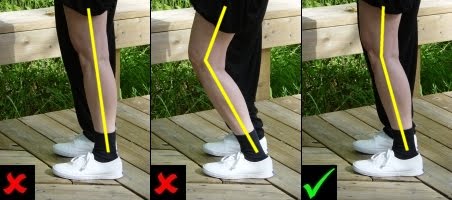
"Did you know you lock your knees when you stand," she asked me. I recently re-joined Healthworks and was using one of my two free personal training sessions that comes with a new membership.

"Try just standing," she said, so I got up, facing her, and felt my legs tense and my knees lock into place like the lid of a Tupperware container snapping shut. This was how I always stood. I never thought about it. Sometimes I'm guilty of the tall girl syndrome of slouching, but I didn't think there was anything wrong with the position of my knees.

"Try softening your knees," the personal trainer, Ann, advised. "it will work different muscles in your legs that you've been neglecting. Otherwise you're at risk for arthritis and other joint problems later in life."

Great. Something else I've been neglecting--like answering emails from friends and hand washing that pile of delicate sweaters I haven't been able to wear in a year. Should I be adding "soften knees when standing to avoid early-onset arthritis" to the to-do list?

Since meeting with Ann I've had moments of mindfulness about my stance and have softened my knees. In line at Trader Joe's. Waiting for the "T." It's hard to change something that you automatically do. It's like a mouth breather suddenly breathing through their nose (I've never been able to do that, no matter how cottony my tongue tastes in the morning.)

What do they always say in meditation (#21 on my to-do list: meditate more)? Return to the breath. Return to softening your knees. Return to going to the gym. Return to writing that sentence. Return to the present moment.

And again.

Sunday, January 2, 2011

Going over to the dog side


"There is no psychiatrist in the world like a puppy licking your face."--Ben Williams

I once had a dog named Muffin. He was a mutt we adopted from the ASPCA and my first real pet (tadpoles and lizards don't count.) My dad built a wood doghouse for him, with a sign bearing his name and a little red heart. There's a picture of me when I was around 7-8 years old, huddled in a blue cardigan sweater in the Autumn chill, my arms wrapped around Muffin as he sits in his new little house.

I'd like to say that Muffin and I became best buddies, that he slept at the end of my bed every night, that I paraded him around the neighborhood with me, and that he leapt with excitement every time I got home from school or dance lessons. Actually, my parents ended up bearing the burden of training him, cleaning up after him, taking him for walks, and feeding him. I was a terrible pet owner--what I really wanted was an animated stuffed animal or a cartoon dog like Snoopy, who never needed a pooper scooper and who could entertain himself with WWI stories and the Red Baron when I wasn't around. I wasn't prepared for this living, breathing, barking, salivating, needy dog. Meanwhile, my parents struggled to train him, but not knowing much about dogs, they ended up being dragged through the streets at the end of Muffin's leash and they had to keep him outside on a long lead because they hadn't fully house-broken him.

Our family ended up giving Muffin away after losing a silly lawsuit having to do with Muffin's incessant barking at night and a neighbor's wife who complained. The sad thing is, I didn't even notice Muffin was gone for at least a day, maybe two. When I finally realized that he was missing, I cried to my mother, who reminded me of my delayed realization of the loss and who assured me he had gone to a loving family who "lived on a farm" (which even to this day they swear is the truth). My father felt bad for me, though, and gave me a Cookie Monster alarm clock as a consolation prize. I remember being more disappointed that my Dad didn't realize that I had long outgrown Sesame Street characters than I was about losing the family dog. I was secretly relieved to have our house back to normal and my parents' attention trained exclusively on me.

For years after I identified myself as more of a cat person. I have a strong affinity for cats because I find them elegant, graceful, independent, and interesting to watch. Basically they have all the traits to which I aspire to have myself.

Mike is also a cat person. He likes to say that he can judge if he's going to be friends with a guy by how that guy feels about cats. When our nephew Matt was going off to West Point, Mike advised him to keep this in mind. Months later when Matt was back home on break, he acknowledged that his Uncle had been right--guys who liked cats were definitely nicer than those who did not.

My husband and I currently have two Tuxedo cats, Audrey and Joey Thumbs. Audrey tends to favor me, while Joey usually chooses Mike's lap when she wants to snooze. I thought two cats was enough--more cats and I'd be perilously close to verging into "Cat Lady" territory. I'm very sensitive to the prospect of anyone calling me a "Cat Lady" since that image is not exactly synonymous with elegance and grace, but of someone who rarely brushes her hair and whose furniture is covered in cat hair and house is packed floor to ceiling with cat-embellished clutter (I would make a crack about people who wear cat sweatshirts, but I know some older women who might take that personally).

Occasionally I thought it might be fun to have a dog. But Mike worried about the responsibility and the end of our free-wheeling lifestyle of partying at the clubs three nights a week (at least). The truth is he was concerned because we both have full-time jobs and it would be mean to subject a dog to life in a modestly-sized apartment with no proper yard and no one home until 7 or 8PM every night.

So it was basically a "Christmas miracle" when, on a Saturday in December when we were out looking for a Christmas tree, we ended up adopting a rescue puppy from a kill shelter in Arkansas. Carmelita was the most excited little thing I had ever held in my two hands, and when she started licking my face I knew I had to have this tiny dog (Was it part Chihuahua? Daschund? No one knew). My husband, who I like to tease for his various eccentricities but who really has a generous heart, asked me if having a puppy would make me happy. I imagined walking Carmelita around our neighborhood, chatting with other dog owners who just minutes ago were strangers standing next to me at the dog run, taking the puppy to one those dog bakeries that have become so popular and buying her a cookie shaped like a bone. Owning a dog opened up a whole new world of possibilities. I was already in love with her warm puppy smell.

We signed the papers and Mike handed over the Christmas money that was originally going to buy a new Lulu Guinness purse for me.

"You know this is your Christmas present, right?" he asked, making sure I understood that there would be no British handbag under the tree this year.

"I know." Who cared? A designer purse can't lick your face and wag it's tail in a frenzy of excitement at your mere existence. It was merely pretty arm candy, not true love.

So has owning a dog for the last three weeks made me a happier person? I think so. I consider this my chance to make up for my absentee-ownership of Muffin. I get to roll around on the couch with a puppy nipping at my face, I'm entertained at the breakfast table by her running back and forth across the kitchen floor, gripping a paper tube three times her size between her tiny teeth. I laugh every time we put her in her little doggie parka to go outside (see pic above). And just today as we were taking her for a walk around the block strangers did in fact stop to interact with her. Dogs have a way of making people smile and even though I know they weren't smiling at me exactly, I still felt a little bit more connected to these former strangers. One woman actually said to us that seeing Carmelita made her 2010, although I find that over the top, and if true, a little sad.

The best moment is when I'm lying on the couch reading, an afghan covering my legs, a cat sleeping on my feet, and Carmelita dozing on my chest. Pure bliss.


Wednesday, December 1, 2010

All in the Family


"When we have an open house, we open our doors and we say everyone can come. No one has to bring an invitation, no one has to meet a dress code. We don't go to the door and say, 'you can come, you can't come. You've got a dreadful tie, you stay out. You're the wrong age. You're the wrong color. You're the wrong sexual orientation.' Open house doesn't do that. Complete hospitality doesn't do that. It's just open. It's more than open, it's actually welcoming. It's appreciative of all the people who show up. The basic attitude is that all human beings are fundamentally worthwhile--fundamentally, basically good. We are delighted to see them and we rejoice in their progress in waking up."--Karen Kissel Wegela, PhD, from What Really Helps: Using Mindfulness & Compassionate Presence to Help, Support, and Encourage Others

Every Thanksgiving it's the same. The glossy magazines have pictures of food-styled turkey on their covers, along with teaser headlines like "How to Cook the Perfect Turkey" (most people would settle for a turkey that's "not so dry that it splits in half", a true story I heard from someone recently); "How to Avoid Those Extra Holiday Pounds" (eat Quinoa stew at home then show up to the party full while everyone else is enjoying the cheese board and jumbo shrimp cocktail); and "How to Survive Dinner with the Family."

Growing up an only child, I didn't have big Thanksgiving dinners with assorted relatives and their partners and children. Typically it was just Mom, Dad, and me, our over-sized turkey and our frozen Mrs. Smith's Pumpkin Pie. But Christmas Eve was definitely a family affair, particularly when I was eight and met my grandfather for the first time.

My father is part Sicilian and if any stereotype about Sicilians is true, it's the one where relatives in a dispute proclaim each other "dead", as if the other person's passing is a foregone conclusion and there's no need to even visit the gravesite. I wonder if any other nationality plays this "dead to me" game. The Italians are notorious for it. I think I'm actually "dead" to a second cousin because I didn't invite him to my wedding. I didn't invite him because his son was getting married the next day and I didn't think he could make two weddings in one weekend. (Not that he ever asked me the reason; he just pointedly ignored me at my great-uncle Victor's funeral).

My father and my grandfather were in a dispute over various gripes, one being the fact that my father ran off with my non-Italian mother to marry in California in 1969 (she was 20, he was 19). My grandfather also didn't like that my dad was in touch with my grandmother, who he had divorced years earlier. But an actual death in the family precipitated a phone call between my father and grandfather, which then led to a meeting. My grandfather had softened with age, my father told us later. I'm sure my father missed him. When I imagine it now, I'd be heartbroken if I hadn't seen or spoken to my dad in ten years.

We reunited in my grandfather's apartment in Bensonhurst, Brooklyn, which was the first time I met my grandfather, a small, almost completely bald man, with a protruding belly like Santa Claus and ash-stained fingers from a lifetime of smoking. For the most part it was a peaceful reunion--except for one outburst of tears from my grandfather's second wife that caused a small ripple of raised voices that soon died down. I think everyone in the room had decided that the past was the past and not to be dwelled on when there were cannolis and espresso to be served.

After that initial visit we went to Bensonhurt regularly, and always on Christmas Eve. Most of the people at the long, clear-plastic covered dining table spoke Italian while my mother and I--who could only understand the occasional phrase, like "Madonna" which sounded like "Ma Doun" to our ears because the Italians like to cut off the last vowel sound, like in "ricotta" and "mozzarella" which became to our ears "rigoat" and "Moozarel".

Despite the fact that my mother and I didn't quite fit in (for instance, we were bookish and disliked fake nails), I enjoyed my big, loud Italian family. I was proud to introduce my Lithuanian-Jewish best friend one Christmas Eve and thrilled when they welcomed her with open arms once they saw how she willingly ate the Octopus appetizer (those tentacles and suckers gave me the creeps--I couldn't even be in the same room with them).

The fact that we were different was something exciting for me, and having this large family that I hadn't known about for the first eight years of my life made me feel special, more interesting. Like so many Americans, I came from a diverse background of not only Sicilians but French people and Swedish. Although I was always close to my parents (as most Onlies are) I was thrilled to have these extended roots, even if they did stretch out in disparate directions.

Now that I've married into another family, I am once again sitting around the table with people I might not have met or gotten to know otherwise. Some of my new relatives are more conservative than I am, or braver, or more handy. I have a nephew, a West Point graduate, who is going to a survivor camp somewhere in the swamp land of the south. He does this willingly, even eagerly. My other nephew just got a job as a fire station dispatcher. I know almost nothing about being a fireman except that I would not be the one entering a burning building but the one fleeing it. And I have an introspective niece who has found her voice doing college plays. Mike and I try to see each production once. If I didn't have family, I wouldn't be sitting in a private college gym 's auditorium, watching 18-21 year-old college students dressed in red face paint, gyrating to loud German death metal (the play was an updated version of Dr. Faustus).

Being open to learning about people who are different than you may be off-putting at first. We all like to gather in our little clans of like-minded souls. But family forces us to expand beyond that limited circle and gain some new perspectives. I'm grateful to have family. Each in their own way, they help me to be a better person.

Monday, November 15, 2010

The Merry Pranksters


"Buddha once said that if we're hit by an arrow it will surely hurt, but if we're hit by a second arrow in the same spot it will hurt much more. This may sound like common sense, but if we use the second arrow as an analogy to help clarify the harmful qualities of the thinking mind, its meaning deepens and becomes more useful. For example, if we get a headache, there's no doubt it can be somewhat painful. But if we have the thought "This is terrible" or "Why is this happening to me?" it's like being hit with a second arrow, and it intensifies the physical pain. As we observe ourselves, we'll see that we shoot ourselves with second arrows quite regularly, even though we're normally not aware that we're doing this."--Ezra Bayda, from Beyond Happiness: The Zen Way to True Contentment

I was walking to the "T" station this morning, trying to focus on looking at the trees and appreciating the colors of the few leaves clinging to the branches and scattered along the sidewalks like paths of petals. Neighbors still have their Halloween decorations up, even though it's mid-November--my first thought was "OK, you've had almost two weeks to take down the golf ball ghosts from your tree. Get with it." But then I caught myself being judgmental when the exercise for the morning was just to be present, to notice my surroundings without commentary.

I live in a lovely neighborhood, but sometimes I see things--minor things--that annoy me more than they should. Early in October, I spotted a seasonally-appropriate family of Jack-O'-Lanterns on someone's front steps. Or at least 3/4 of the family were there; on the sidewalk, perilously close to the front wheel of a parked car, was a pumpkin that had been kicked in the head, leaving a large gaping hole. Pulp spilled out of the hole like brains. Mardi Gras beads lay beside the "head." It looked like all of the pumpkins had been decorated by children--instead of cut outs for eyes, nose, and mouth, there were stickers representing the pumpkins' facial features.

I imagined these children--maybe a 4 year-old and a 6 year-old--coming home from school and discovering their mangled friend. They would be perplexed--how could someone do this? It would be their first insight into the petty meanness of strangers. Years later they would remember the gouged Jack O' Lantern when they found spit-up food smeared on the front of their locker, or a hole punched into the wall of their apartment and their favorite gold bracelet stolen (yes, these things happened to me, and no, the perpetrators were never found. Dammit.)

I picked the pumpkin off the sidewalk, stood it back up on the steps, with the gash facing away from view, then tried to drape the Mardi Gras beads over the hole with some success.

There. The world was right again. Or at least MY world was right.

The next morning I was walking past the same house, and saw that same pumpkin lying smashed on the front lawn.

So today, while observing trees and autumn colors and seasonally-inappropriate decorations, I passed a poster for a missing cat. It looked like a Maine Coon cat, gray and white with a fluffy tail and an old man's wisps of white coming out of its ears. Next to the picture of the cat someone had scribbled "he tasted good." I walked by, contemplating some person's poor attempt at a joke. I thought of the owner, the family even, who were missing their beloved pet. They would see the poster and automatically envision their friendly, lost cat, roasting on a spit. I was a block away from the sign but I turned around and went back to the tree and scribbled out the written-in message. I knew to the outside world I probably looked crazy, but I didn't care.

I tried to resume my mindfulness exercise, but as I approached the "T" station I found I was losing the battle. Why do people have to suck so much? There's enough bad stuff in the world, why pile on the meanness?

And by getting irritated by these small pranks that were probably committed by bored middle-school boys, I had successfully demonstrated how we twist the knife further by being reactive.

Tuesday, October 26, 2010

The myth that persists


"Just like 'aspirational' airbrushed advertising in women's magazines, reality TV beauty programming invites female viewers to envy models' unrealistic figures, and, by proxy, their clothes, cosmetics, shoes, and lifestyle products. Though impacts vary, decades of research have documented that women's self-esteem often drops with exposure to advertising and ad-driven media."--From Reality Bites Back: The Troubling Truth About Guilty Pleasure TV by Jennifer L. Pozner

"Beauty. It touches everything."--Calvin Klein perfume ad

When I lived in New York and worked in midtown, I'd often find myself walking through Times Square to get to my office at 1745 Broadway. Loud, flashy, over-the-top, Times Square is the tackiest of tourist meccas. It impressed me as a child when my parents would drive through it on our way to see a Broadway show. I remember feeling awed by these giant photographs of models and celebrities and Coca-Cola ads. But as an adult, the images on these oversized billboards made me feel uneasy, dwarfed as I was by these scantily-clad Amazon women posed suggestively in the latest Calvin Klein perfume ad or H&M poster.

During most of my time living in New York, when I was in my twenties and early thirties, I was naturally thin. I didn't diet or exercise religiously. In fact I loved food--going to new restaurants was one of my favorite activities in the city and where I used up most of my disposable income. Restaurant Week, when assorted expensive "It" spots offered lunch for $20 and dinner for $30 to us average-salaried workers, was especially exciting to me. As soon as the participating list of dining establishments was posted, I'd be making plans and reservations, emailing friends to quickly line up dates.

Not worrying about what I ate or how much I weighed was a tremendous freedom that I tried not to take for granted. I had other insecurities, but at least in this area I felt confident.

Looking back at my life then, I realize that being thin was nice (especially the whole eating-what- I-want-and-never-gaining-weight part), but it didn't save me from feeling bad about my appearance. Being thin didn't translate into looking like a model or loving myself in a bikini. It didn't make me feel more worthy of a good relationship or confident enough to wear sweatpants in public. I didn't chastise myself about what food I ate, but neither did I think I was good enough in a city filled with images of perfection.

The thing that saddens me about this is even knowing that fitting a particular beauty standard doesn't necessarily make us happy, many of us still aspire to be as perfect as those Calvin Klein models. We may not even know that we're thinking this way, but looking back I see how much importance I placed on appearance and how I rarely measured up to its tough dictates. I immediately felt inferior to prettier friends though I tried not to let it affect our relationship. I would feel unfashionable in a skirt I bought six months ago and feel compelled to buy something new to wear out that night. The feeling was more of a compulsion than an actual choice.

Some women are able to see past the "Beauty Myth," the title of a popular book I read in the nineties. But a lot of us are susceptible. When you're confronted by images that are exalted on advertising posters and in magazines, and you don't resemble those images, after a while this high beauty standard starts to feel like the norm, which can only mean, my dear, that you are abnormal.

I regret not having taken advertising classes in college. Mike talks about a class he took that really changed how he viewed marketing strategy. Even as a college-educated person, I never stopped to evaluate these images and wonder what they might be trying to tell me, namely, buy this and you'll feel better! The answer is beauty and acceptance and if you only buy me you will have these things in spades!

I like to joke that, even though I've worked in marketing, I'm a sucker for packaging. But it's not just the rose-shaped pallets of eyeshadow in a $79 Chantecaille kit that captivate me--it's the longing--informed to a large degree by messages in advertising and television--that have effected how I view my own packaging.

Many women strive to be thin and flawless--it's almost impossible to find a women's magazine that doesn't emphasize this wish and insist we can achieve it by reading another 4-page article filled with "essential" tips and "must-have" products. The most successful woman can be made to feel inferior by just ten minutes of reading Elle or Glamour or even O magazine. As a publicist it's part of my job to look at magazines. Thankfully I've ended up at a Buddhist publisher, where the women in magazines are often bald and wrapped in plain robes. But that doesn't mean I'm not also looking at more traditional publications that always feature young flawless models, even when promoting an anti-aging cream.

There's nothing wrong with wanting to look nice. I happen to love clothes because I like the challenge of finding good pieces and matching them into outfits. I have never outgrown the pleasures of dressing up. But though they may "say" otherwise, beauty ads and diet articles that claim they're helping you to"look your best," are really saying "look like her" (fill in model's name/picture.) Is it any wonder women feel less-than? Is it at all surprising that we silently compare and compete with each other?

I'm older now and not as thin as that city girl I was. When I start to feel bad about that, I try to call to mind how being thin didn't really change how I viewed myself. It was nice when I went to try on jeans and had no trouble finding a good fit even on the first try. But it didn't make my life infinitely better or more valuable.

Everyday I fight the urge to give in to the hundreds of messages that call out to me like sirens from the Odyssey. Often their invitations seem innocent, even helpful:"Sabotage cellulite 24/7 with our all-day, dimple dashing duo" (Bliss) or "Tired of looking tired? We hear you (Origins.)" Sometimes they're downright aggressive (open any Victoria's Secret catalog.) The thought of not "buying into" advertising can be disappointing--you mean self-confidence and contentment can't be bought at Sephora?

If only it were that easy.

Sunday, October 17, 2010

Choose compassion

"Young Americans today live in a world of endless connections and up-to-the-minute information on one another, constantly updating friends, loved ones, and total strangers about the minutiae of their young, wired lives. But new research suggests that behind all this communication and connectedness, something is missing. The study found that college students today are 4o percent less empathetic than they were in 1979, with the steepest decline coming in the last 10 years."--from "Empathy is so Yesterday" in the Boston Sunday Globe (October 17, 2010)

"What difference would it make in your life if you engaged the world with a conscious commitment to end sorrow or pain wherever you meet it? What difference would it make to wake in the morning and greet your family, the stranger beside you on the bus, the troublesome colleague, with the intention to listen to them wholeheartedly and be present for them? Compassion doesn't always call for grand or heroic gestures. It asks you to find in your heart the simple but profound willingness to be present, with a commitment to end sorrow and contribute to the well-being and ease of all beings."--Christina Feldman, from Compassion: Listening to the Cries of the World, excerpted in The Buddha is Still Teaching: Contemporary Buddhist Wisdom

My Alma Mater Rutgers College was in the news recently, but not for producing a Noble Prize winner or hosting president Obama in anticipation of the midterm elections. Freshman Tyler Clementi jumped to his death from the heavily-trafficked George Washington Bridge in New Jersey. The suicide was the result of a cruel prank committed by Clementi's roommate, Dharun Ravi, and Ravi's friend and accomplice, Molly Wei. They thought it would be hilarious to use a webcam to broadcast Clementi having a private, sexual encounter with another man.

Were Ravi and Wei cruelly demonstrating their personal homophobia? Probably. But it seems to me that--if you listen to the media--Clementi's tragic story is one of many that we've heard in the past few years involving young people and the Internet. From Megan Meier, the 13 year-old girl who killed herself after being duped by a neighbor into thinking she was developing a relationship with a "cute boy" on MySpace, to Phoebe Prince, who was not just "bullied" but downright harassed by classmates whose constant taunts on and offline led Prince to commit suicide. Reports have said that the teenagers continued to mock Prince on Facebook even after learning of her death.

When I read these stories I can't help but feel that "Generation Wi-Fi" lacks compassion for others, and, even keeping in mind the extreme nature of these stories, I wonder if there aren't more cases of shaming and cruelty happening in this country as a result of the digital boom of the last ten years. I think it has been amply demonstrated that sites like MySpace and Facebook have distanced kids from each other, making it easier for them to lash out online without the consequences, of say, being punched in the face or cursed out live and in person. Worse, the incriminating videos or vicious rumors are not like a nasty note passed between a few girls that ends up crumbled in the trash. They can easily be passed on to anyone in the world and tend to stay online indefinitely. That's a far cry from when I was a teenager, and my worst fear was a stray insult lobbed at me from across the hall. No, this meanness sticks.

But is it entirely Facebook's fault for the increasing number of cyberbullies, or is it the culture at large--with unreal "reality" shows making women, minorities, gays--basically anyone who strays from the mainstream--into the butt of viewers' laughter and scorn and where the modern cult of celebrity has made us as narcissistic as a 16-year-old pop star? It's true that we are living in an age when Google enables us to peek into the lives of others without the slightest effort to really get to know them. Worse, real people's lives can be toyed with as if they're just another source of entertainment on a dull Tuesday night in the dorms. But is that the fault of an efficient search engine or is it more like road rage, when the irrational desire to cut off the car that cut us off is easily played out without either driver even seeing the other, much less communicating with him.

In the Globe, reporter Keith O' Brien does acknowledge that "empathy is such a basic ingredient of the human experience that even babies exhibit it, crying when other children cry or reacting to the facial expressions of adults and parents." But while few young people would openly mock their college roommate about his sexual preferences, there are many like Ravi and Wei who have no problem exhibiting the same mockery online for a few laughs.

Technology and social media are only as good or as evil as its human users. "We are tempted to think that social-media technology drove the behavior, but as a truly ethical matter, the behavior has to be and should be considered human-driven, not technology-driven,” says Scott Foulkrod, a philosophy professor at Harrisburg University of Science and Technology in Pennsylvania, talking to the Christian Science Monitor ("Rutgers Student Death: Has Digital Age made students callous?" October 1, 2010) A person's capacity for both compassionate acts and acts of cruelty have always been present. But the means by which we can act upon our cruelest thoughts have changed, and as a result, young people growing up with the Internet may be tempted to act out some of their darker impulses online, where restraint in the presence of the other person is essentially eliminated.

I'm fascinated by what drives people to do cruel things to each other. I'm also struggling with the concept of human beings being multi-dimensional. Reading Buddhist teachings has taught me that even those who commit evil acts aren't inherently evil. Reading stories like Clementi's makes my guts clench with anger. Someone should shame those two co-conspirators with a webcam trained on THEIR most private lives, I think. But that is not showing compassion, that is making the world into "Us" and "Them," where anyone under 20 is regarded as a narcissistic jerk or worse. I've met many young adults who have shown kindness and compassion, even online. Kids are still reaching out and supporting each other, like in the story of 16 year-old Esther Earl of Boston, who had an online following of admirers who helped her battle thyroid cancer and who, even after her death, spoke of her as if she had been a favored schoolmate and not a girl they met over the Internet. I think that Earl's short life was definitely enriched by her online supporters, and that their good wishes for her show that not every young person uses social media for ill.

I do hope that there are more stories like that of Esther Earl. Our compassion for one another is what makes our common suffering easier to bear. I'd hate to think of a future where we're so distant from each other that feeling empathy for someone is considered a weakness or a waste of time.

Friday, October 8, 2010

(Dis) Contented


"The way we know things depends upon the mind, nothing more. Most of us have moments of deep contentment when we don’t feel a need to alter, express, run from, or invest some special meaning in our experience in any way. Deep contentment shows us that, at least momentarily, our habit of cherishing and protecting ourselves from what we call “other” has subsided. In moments like these, we have stopped objectifying things. We can let things be. And when the mind rests at ease in this way, it accommodates everything, like space." - Elizabeth Mattis-Namgyel, The Power of an Open Question

If there was a caption running over my head, something that others could see but I could not (and let's face it, there are many things we can't see about ourselves that others can perceive without fail), my caption would be "Not enough."

No matter what I set out to do, in my mind it's "Not enough." When I look in my closet, instead of seeing a reasonable wardrobe for a woman in her thirties who is neither rich, nor famous, nor a fashion model, I think "Not enough." When I look at my achievements in my chosen profession, I don't see the things I got right; I see "Not enough." When I'm getting ready to go out to dinner with Mike or meet a friend at a restaurant, I look in the mirror and almost always say, "Not enough."

I once read a book called Enough. In it, the author talks about how we are bombarded with everything from information we want to absorb, to advertising tempting us to buy more, to multiple choices at the supermarket where there is always a fresh product claiming to be new and improved. When I was younger and used to read Self magazine (a woman's mag whose title says it all) I would write a list of all the products they recommended for women like me--volumizing shampoo to make my "fine" hair as puffy as a an eighties soap opera star; spot cream to minimize the sun spot on my left cheek that an Origins saleswoman was "kind" enough to point out to me; even cellulite cream to reduce the unsightly fat cells that had appeared on my legs after I gained a few pounds in my thirties.

I still make lists, and they tend to take up multiple sheets of paper. I'm not just making lists of products, but of restaurants I want to try, books I notice while reading Publishers Weekly, vacations I want to take, websites I want to bookmark so I can visit them later. My head is often filled to distraction and once one thing is crossed off the list, I'm off to the races, on to the next item. There is very little time for contentment at what I've acquired or achieved or completed. Never enough.

A person could live their whole life this way, but that would be a sad existence. And I'm not saying that we shouldn't jot down a good idea or an interesting web address or a product we'd like to try, even if we know it will probably have the same effect as the last product we tried, which is not much. Maybe this shampoo will smell really good, and that will be enough.

The problem for me (and for the people around me whose lives I directly impact) is that I find I'm very often discontent. And I know I'm not alone in this. Take a perfectly nice day, walking around looking up at the trees changing color (early this year for New England), smelling the pizza being served up at a neighborhood restaurant, seeing people laughing among themselves, and all I'm thinking is what's not right about the situation. Like those puzzles that ask you to find inconsistencies between two pictures, I notice what's wrong--I'm sweating a little in my new trench coat (why did I decide to wear this in September when I know the weather is fickle?) I stumble over the pavement and almost fall down (why can't I walk straight, why am I so clumsy?) I miss the train (that driver saw me and yet he still pulled away. Why does he hate me?)

And there goes another lovely fall day in my wacky world.

Increasingly I agree with the writers and psychologists and spiritual leaders who say that contentment is the most rewarding feeling we can hope for, better than just some abstract goal like "happiness." To paraphrase a quote I read in O magazine (which I read despite the fact that her notion that "we're beautiful as we are, but here are pages and pages of my favorite things that you should buy, which, by the way, cost more than you make in a month) "What if instead of trying so hard to change, I embraced all my (insert first name)-ness?" Instead of worrying about what strangers think about the non-thickness of my hair, it's enough that the people who love me don't give a fig.

We're enough. This crowded train I'm on is enough because, despite the fact that it's crowded and a conductor just asked me to type "more quietly," it's taking me to see a good friend of mine. I'm not hanging off a bus filled with people trying to find somewhere--anywhere--to sit. I have a window seat and a table for my computer. That's enough. My spending budget for the weekend would not impress The Real Housewives of wherever, but it's more than enough. (Anyway, there's nothing real about anyone on "reality TV" as I'm reminded when reading a book I recently picked up, Reality Bites Back: The Troubling Truth About Guilty Pleasure TV)

Our life as it is is enough. What we wouldn't do to have just this life back if we found ourselves homeless, hungry, sick, or dying. I was at a funeral for my husband's uncle last weekend. He was 90 and in poor health, so it wasn't a shock--though any family member or friend's death, whether expected or not--always shocks anyway.

Uncle Ken was a quiet man--in the almost ten years I've known Mike I don't recall ever hearing a word out of him. But in fact he had many passions in life--he had a deep love of nature for one--and he had survived heavy warfare in North Africa and Italy in WWII. I suspect that, though quiet, he was a man who felt that on many levels he had enough in life.

I would think that people like that die without too many regrets about what they didn't have enough of.